Understanding Celina's Expansive Clay Soils
Celina is situated atop the Blackland Prairie—one of the most challenging soil regions for residential construction anywhere in the world. The dominant soil type is Houston Black clay, a Vertisol characterized by extreme shrink-swell behavior that has created engineering challenges since the first homes were built here.
The Mineralogy of Foundation Problems
The "why" behind foundation failure in Celina starts at the molecular level. Houston Black clay contains high concentrations of smectite and montmorillonite—minerals whose molecular structure allows for extreme water absorption between layers. When water enters these clays, they can expand by more than 10% of their dry volume.
This isn't subtle movement. Saturated expansive clay can exert upward and lateral pressures exceeding 14,000 pounds per square foot—more than sufficient to lift, crack, and displace residential concrete foundations. Conversely, during drought, these same soils shrink dramatically, removing support from foundation edges.
| Soil Property | Technical Metric | Structural Implication |
|---|---|---|
| Clay Content | Often >60% | High density, low permeability, high shrink-swell risk |
| Plasticity Index (PI) | Often >26 | Classification as "Highly Expansive," may require deep piers |
| Swell Pressure | Up to 14,000 PSF | Exceeds resistive load of typical two-story residences |
| Heave Potential | Up to 7.5 inches | Significant vertical movement risk for slabs and flatwork |
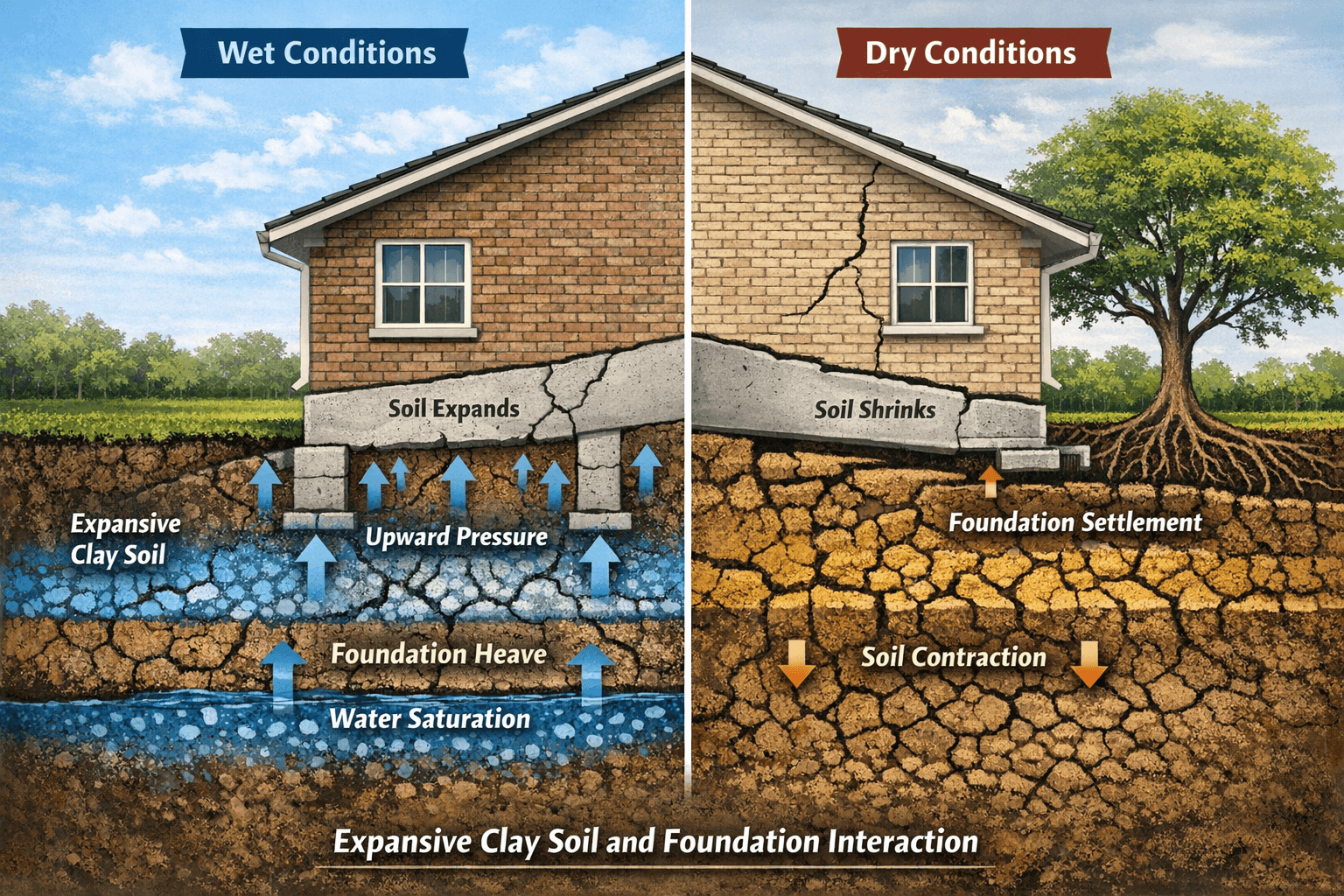
Cross-section showing expansive clay soil behavior and foundation movement during wet and dry conditions.
Uniform vs. Differential Settlement
Not all foundation movement is problematic. Understanding the difference between types of movement is essential to evaluating foundation performance:
Uniform Settlement
When the entire structure moves vertically as a single unit. The home may be lower than originally constructed, but because all sections moved equally, structural stress is minimal.
Generally not problematic if movement has stabilized.
Differential Settlement
When localized moisture changes cause one section of the foundation to shift independently of another. This creates structural distress as the building frame is "racked" by unequal support.
Primary cause of damage in Celina homes—requires attention.
The "Active Zone" and Seasonal Movement
Celina's climate creates a seasonal cycle of soil expansion and contraction often called the "Texas 2-step." The "active zone"—the depth of soil subject to moisture fluctuations—extends several feet below the surface. During wet seasons, water infiltrates and clays expand. During drought, moisture evaporates and clays shrink, often pulling away from foundation perimeters.
This is why foundation maintenance (proper drainage, consistent watering during drought) is so important in North Texas. Extreme moisture variation accelerates differential movement.
Foundation Performance Indicators We Evaluate
Per Texas Real Estate Commission (TREC) Standards of Practice §535.228, our role is to render a professional opinion on the foundation's performance—not simply to identify cracks, but to evaluate whether the foundation is functioning adequately for its intended purpose, considering age and normal wear.
🧱 Exterior Masonry Evaluation
- ✓ Stair-step cracking patterns
- ✓ Horizontal displacement at mortar joints
- ✓ Separation at windows and doors
- ✓ Brick/stone rotation or displacement
- ✓ Control joint performance
Active movement indicator: Stair-step cracks following mortar joints suggest ongoing foundation movement.
📐 Floor Elevation Assessment
- ✓ Multiple-point elevation readings
- ✓ Slope calculation across spans
- ✓ High/low point identification
- ✓ Pattern analysis for cause
- ✓ Comparison to industry tolerances
Threshold: Floor slopes exceeding ½ inch over 10 feet warrant further evaluation.
🚪 Door and Window Operation
- ✓ Frame squareness measurement
- ✓ Operation testing (latch, swing)
- ✓ Gap analysis at tops/sides
- ✓ Weatherstrip contact patterns
- ✓ Correlation with floor elevations
Sticking doors often indicate frame racking from differential settlement.
🏠 Interior Finish Conditions
- ✓ Drywall cracking patterns
- ✓ Ceiling/wall separation
- ✓ Floor covering distress
- ✓ Cabinet and countertop gaps
- ✓ Trim separation
Diagonal cracks at door/window corners suggest frame stress from foundation movement.
When We Recommend Structural Engineering Evaluation
Home inspectors provide performance assessments—we identify indicators that suggest foundation distress. When specific thresholds are exceeded, we recommend evaluation by a licensed structural engineer who can provide definitive diagnosis and repair recommendations.
Adverse Performance Indicators
We recommend structural engineering evaluation when we observe:
- Stair-step cracking in exterior masonry — Indicates active differential movement between foundation sections
- Floor slopes exceeding ½ inch over 10 feet — Beyond acceptable tolerance for residential construction
- Multiple doors/windows with operation problems — Suggests widespread frame distortion
- Horizontal displacement in masonry — Indicates lateral foundation movement
- Evidence of previous foundation repair — May warrant verification of repair effectiveness
Important distinction: An inspection finding that recommends engineering evaluation is not a diagnosis of foundation failure. Many homes show indicators that, upon engineering analysis, are determined to be within acceptable parameters or easily addressed with maintenance changes.
Foundation Maintenance in North Texas
Foundation performance in Celina depends significantly on moisture management. Maintaining consistent soil moisture around your home can prevent or minimize differential movement.
💧 During Drought
When clay soils dry, they shrink and pull away from foundation edges. This removes support and can cause perimeter settling.
Mitigation: Use soaker hoses 12-18 inches from the foundation to maintain consistent moisture during extended dry periods. Avoid overwatering, which causes expansion.
🌧️ During Wet Periods
Saturated soils expand and can exert thousands of pounds of pressure against foundation walls and slabs.
Mitigation: Ensure positive drainage away from the foundation. Extend downspouts. Check that irrigation doesn't over-spray against the structure.
🌳 Tree and Vegetation
Large trees extract significant moisture from soil. Root systems can extend well beyond the tree canopy and affect foundation moisture levels.
Mitigation: Maintain trees at appropriate distances. Consider root barriers for valuable trees near foundations.
🏠 Gutter and Drainage
Concentrated water discharge against foundations is a primary cause of localized soil heave.
Mitigation: Keep gutters clean and functional. Extend downspouts minimum 4-6 feet from foundation or connect to subsurface drainage.
Foundation Types in Celina New Construction
Understanding your foundation type helps contextualize inspection findings:
Post-Tension Slab Foundations
The dominant foundation type in Celina new construction. Steel cables embedded in the slab are tensioned after concrete cures, creating compression that resists bending and cracking from soil movement.
- • Cables must not be cut during renovations
- • Look for post-tension stamp on garage slab or utility room
- • Requires specialized repair techniques if damaged
Pier and Beam Foundations
Less common in new construction but found in older Celina homes and some custom builds. Wood or steel beams span between concrete piers, creating a crawl space beneath the structure.
- • Allows adjustment if settlement occurs
- • Crawl space ventilation and moisture important
- • Wood components subject to moisture and pest damage
Related Services: Structural Inspection | Thermal Imaging (moisture detection) | New Construction Inspection
Frequently Asked Questions
Celina sits on Houston Black clay—a Vertisol with over 60% smectite content that can expand 10%+ when wet and exert pressures exceeding 14,000 pounds per square foot. This creates some of the most challenging foundation conditions in North America. Professional inspection helps identify problems before they become expensive repairs.
Uniform settlement is when the entire structure moves vertically as a unit—generally not problematic if stabilized. Differential settlement occurs when one section moves independently of another, causing structural stress that manifests as cracking, door/window problems, and floor slopes. Differential movement is the primary cause of foundation distress in Celina homes.
Warning signs include stair-step cracks in exterior masonry (especially following mortar joints), doors and windows that stick or won't latch, floor slopes exceeding ½ inch over 10 feet, gaps between walls and ceilings, diagonal cracks at door/window corners, and separation of trim or molding from walls.
Home inspectors identify performance indicators and recommend engineering evaluation when specific thresholds are exceeded. If we observe active movement indicators, significant floor slopes, or structural distress patterns, we'll recommend a licensed structural engineer who can provide definitive diagnosis and repair recommendations.
Protect Your Foundation Investment
Foundation problems don't improve with time. Get professional evaluation and understand your home's structural performance.
Call (972) 640-5861 for availability